Before you start
This guide is general. Our data has no link length, pin type or link count for any watch, so nothing below is specific to a model, and a maker’s own instruction for your bracelet comes first if it differs. What you need:
- A pin pusher in a bracelet holder. A small hammer and a pin punch help with a pin that will not move.
- A jeweller’s screwdriver with a blade that fills the slot, if the bracelet has screws.
- Tweezers, a tray or a cloth with a rim to catch parts, and masking tape over the bracelet where tools rest.
- A ruler or calipers, and eye protection: pins can fly.
Three kinds of pin
Turn the bracelet over. Small arrows on the inside of a link usually mark a pin you push; a tiny slotted head on the side marks a screw.
| Kind | What it is | Taking it out | Putting it back |
|---|---|---|---|
| Pin and collar | A straight, solid pin that sits in a tiny tube, the collar, which fits in the link. The collar can slip out with the pin. | Support the link in the holder, line the pusher up with the pin and push the way the arrow points. Look for the collar afterwards; it is easy to lose. | Put the collar on the pin before you push it home, then press the pin in from the side opposite the arrow until flush. The collar’s position varies by design, so follow the maker’s instruction if you have it. |
| Split pin | A hollow pin with a slit down its length, springing outward to grip the link. | Push it out the way the arrow points with a pusher that matches its diameter. A pusher that is too wide crushes it, and one held at an angle bends it. | Press it in from the side opposite the arrow until flush. A flattened or bent pin will not grip; replace it. |
| Screw | A threaded screw with a slotted head, usually with a threaded sleeve in the link on the other side. | Fit the blade fully in the slot, hold the sleeve side steady and turn counter-clockwise from the head side. The sleeve may drop out when the screw does. | Start the thread by hand, then snug it. A screw forced tight strips its thread or snaps its head; a trace of low-strength thread-locker keeps it from backing out. |
Many bracelets mix them: pins on the links and a screw or a spring-loaded pin in the clasp. An arrow is common but not universal, so a pin that does not move under light pressure is a reason to stop and look again, not to push harder.
Step by step
- Work out how many links. Use the calculator at the top: close the clasp, measure the loop, measure one link. For the example on this page, a 6.75 in wrist with a 215 mm bracelet of 16 mm links needs 2 out, leaving 183 mm of bracelet, 11.6 mm over the wrist.
- Pick which links. Take half from each side of the clasp, so the clasp stays under the wrist. The links beside the case are often shaped to fit it and are not meant to be taken out.
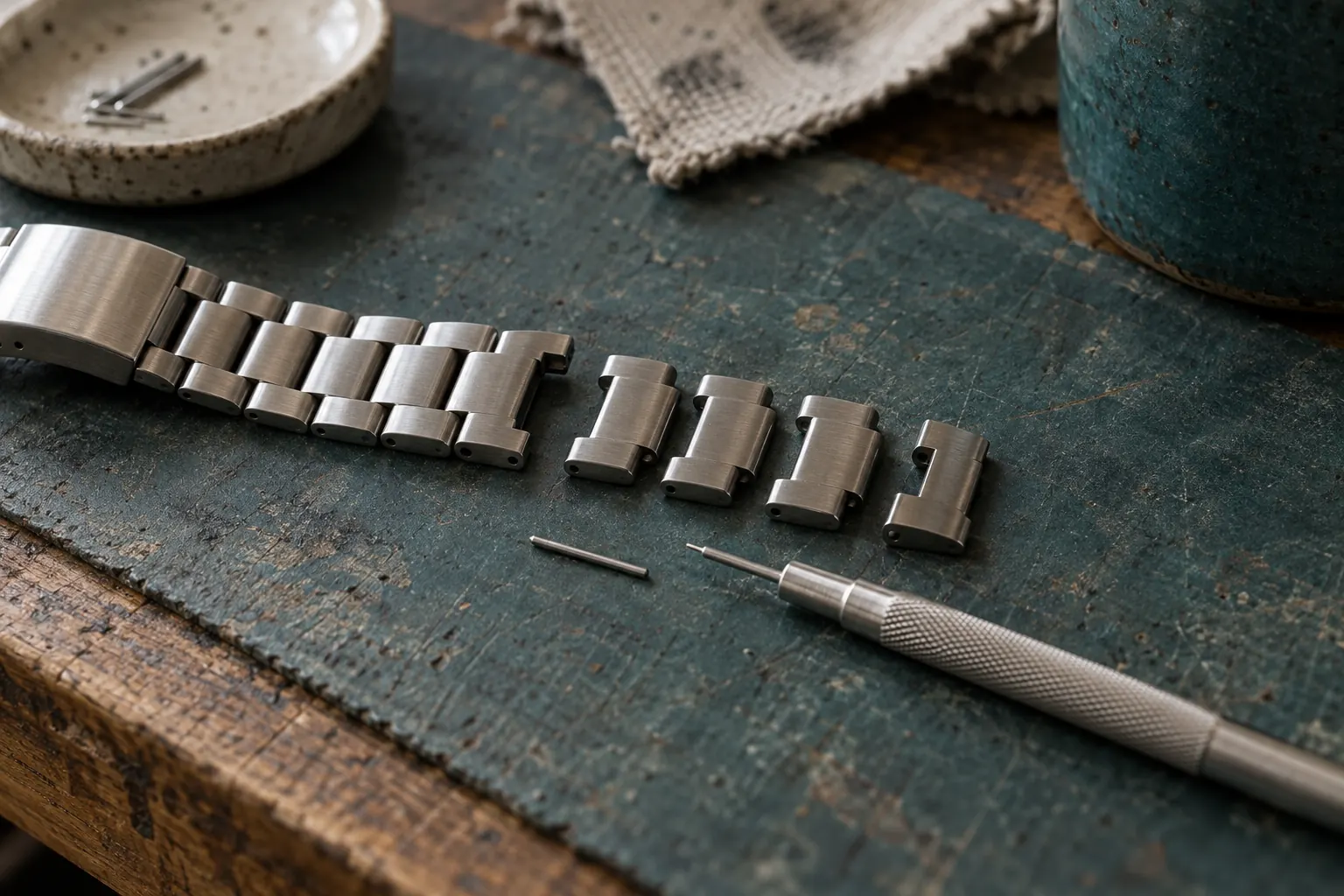
- Set up. Lay the bracelet in the holder with the inside up, tape over the metal where tools touch, and put the tray underneath.
- Take the pin out. Follow the row for your pin in the table. Push slowly and square; the pin should move with steady pressure, not a blow.
- Take the link out and repeat on the other side of the clasp. Keep each link, pin and collar in one bag.
- Join the bracelet up through the gap you made, pins in from the side opposite the arrows, until each is flush.
Check the fit before you wear it
- Flex the bracelet along its length. A link that binds or clicks has a pin sticking out or a collar out of place.
- Run a fingertip along the inside for a pin end that stands proud.
- Close the clasp on your wrist. A fingertip should slide under the bracelet without a gap you could slide a thumb into; the wrist can also swell in the heat and towards evening, so check at the time of day you wear it most.
- If you are between two sizes, take out the smaller number. A link can come out later, and one you removed is only useful if you kept it.
When to take it to a watchmaker
Stop and hand the watch over if:
- you cannot tell which kind of pin it is, or nothing moves under gentle pressure;
- the links are solid or folded and show no pin on the inside, or the bracelet is integrated into the case;
- the watch is valuable, the bracelet is precious metal or ceramic, or you are not sure resizing yourself is allowed under its warranty;
- you are within a link of the right length and need a half link or a clasp adjustment, which are different parts of the bracelet;
- you have bent a pin or marked a link.
What we know about your bracelet
Less than the steps above need. Our reference has a lug width for 140 of its 241 watch models (the commonest is 20 mm, on 65 of them), but not how long a link is, how many links the bracelet has, or what holds them together. That is why the calculator asks you to measure. If you find a number in a maker’s document that we should carry, the contact page has the way to send it, and the methodology page explains how we check what we add.