The kinds, counted from our data
A movement is the engine of a watch. What separates the types is what stores the energy and what sets the pace, and the table says which is which. The counts are movement files in our reference, one per calibre or module, so they show what we have collected and not how many of each exist.
| Type | Runs on | In our data | Examples |
|---|---|---|---|
| Automatic | A mainspring, wound by a rotor that swings with your arm and on most also by the crown. | 62 movements, from 11 makers (Citizen, Dixmont, ETA, Hamilton, …). | 4R36, NH35, Miyota 8215, ETA 2824-2 |
| Manual (hand-wound) | A mainspring wound only at the crown, with no rotor. | None yet. | — |
| Quartz | A cell you replace every few years. | 14 movements, from 4 makers (Casio, Citizen, Miyota, TMI). | Miyota 2035, VH31, Casio 5069 |
| Solar quartz | Light, stored in a rechargeable cell. | 22 movements, from 2 makers (Casio, Citizen). | Citizen E168, Citizen B612, Citizen H500 |
| Kinetic | Arm movement: a rotor turns a generator that charges a rechargeable cell. | None yet. | — |
| Mecha-quartz | A cell; the chronograph is built like a mechanical one. | 2 movements, from TMI. | VK63, VK64 |
| Spring Drive | A mainspring, regulated electronically rather than by a balance. | 1 movement, from Seiko. | 9R65 |
| Casio digital and analog-digital modules | A cell, or a solar-charged one, depending on the module. | 68 movements, from Casio. | Casio 593, Casio 5611, Casio 3298 |
The “Runs on” column is general background, the same for any watch of that type. The other two columns come from the data. A module is a movement sold only inside one maker’s watches, which Casio identifies by the number printed on the caseback; the Casio modules are listed apart for that reason.
Automatic and manual
Both are mechanical. A mainspring stores the energy, a gear train passes it on, and a balance wheel with a hairspring lets it out in equal steps. The balance in 62 mechanical movement files beats 21,600 or 28,800 times an hour, which is 6 or 8 steps a second, and that is why the seconds hand seems to sweep.
The difference between the two is the rotor. An automatic has one and winds as you move; a manual watch is wound at the crown, normally every day. The line is blurrier than it sounds, since 40 of the 43 mechanical files that state it also allow winding by hand. Only 3 do not, and they are listed in the quartz vs automatic comparison, which also has their accuracy and power reserve.
No movement file here is typed as manual, so that row counts 0. That is a gap in our collection, not evidence that the type is rare.
Quartz, solar, Kinetic and mecha-quartz
All four keep time with a quartz crystal and differ in where the power comes from. The seconds hand of an analog one usually steps once a second, though makers add exceptions, so do not use the tick as the only test.
Quartz
A coin cell powers the crystal and a small motor moves the hands. We hold 14 movements filed simply as quartz, from Casio, Citizen, Miyota, TMI; Seiko’s battery chart adds 1,261 calibres with a battery life, most often 2 years5.
Solar quartz
A solar cell under or around the dial charges a rechargeable cell. Citizen’s own range is called Eco-Drive. There are 22 in the data from Casio and Citizen. Run time is given in the dark, from full charge to empty: the B612 is rated 7 months3.
Kinetic
A Kinetic watch is a quartz watch charged by motion. A rotor like an automatic’s spins a generator, and the rechargeable cell it fills runs the movement. We hold no Kinetic calibre yet. Seiko’s battery chart names a rechargeable unit or a capacitor for 27 calibres5; that group is where solar and Kinetic calibres turn up, and the chart does not tell them apart.
Mecha-quartz
Mecha-quartz is a quartz movement whose chronograph is built to work like a mechanical one, with the feel of one. We hold 2, TMI’s VK63 and VK64, the VK64 rated at 3 years4 battery life. The name is a collectors’ label: TMI’s own technical guide calls the VK6 series analogue quartz, and our files carry that disagreement as a note.
Spring Drive
Spring Drive is Seiko’s own category. A mainspring supplies the energy and a quartz-based regulator sets the pace, so the seconds hand glides instead of stepping or beating. We hold one, the 9R65, rated ±15 s/month1 with a power reserve of 72 h1. It needs no battery, and its rating is closer to quartz than to any of the automatics in the data.
How to tell which one your watch has
- Look for a screen. A digital or analog-digital display means an electronic module. The Casio modules in our data are all of this kind.
- Watch the seconds hand for ten seconds. Ticks once a second: quartz family. A smooth sweep: mechanical (the ones we hold beat 6 or 8 times a second) or Spring Drive.
- Read the dial. “Solar”, “Tough Solar” or “Eco-Drive” on the dial marks a solar movement, and a dial that is dark and slightly translucent often hides the cell. “Automatic” may be printed too, but dial text is the brand’s choice, so it confirms rather than proves.
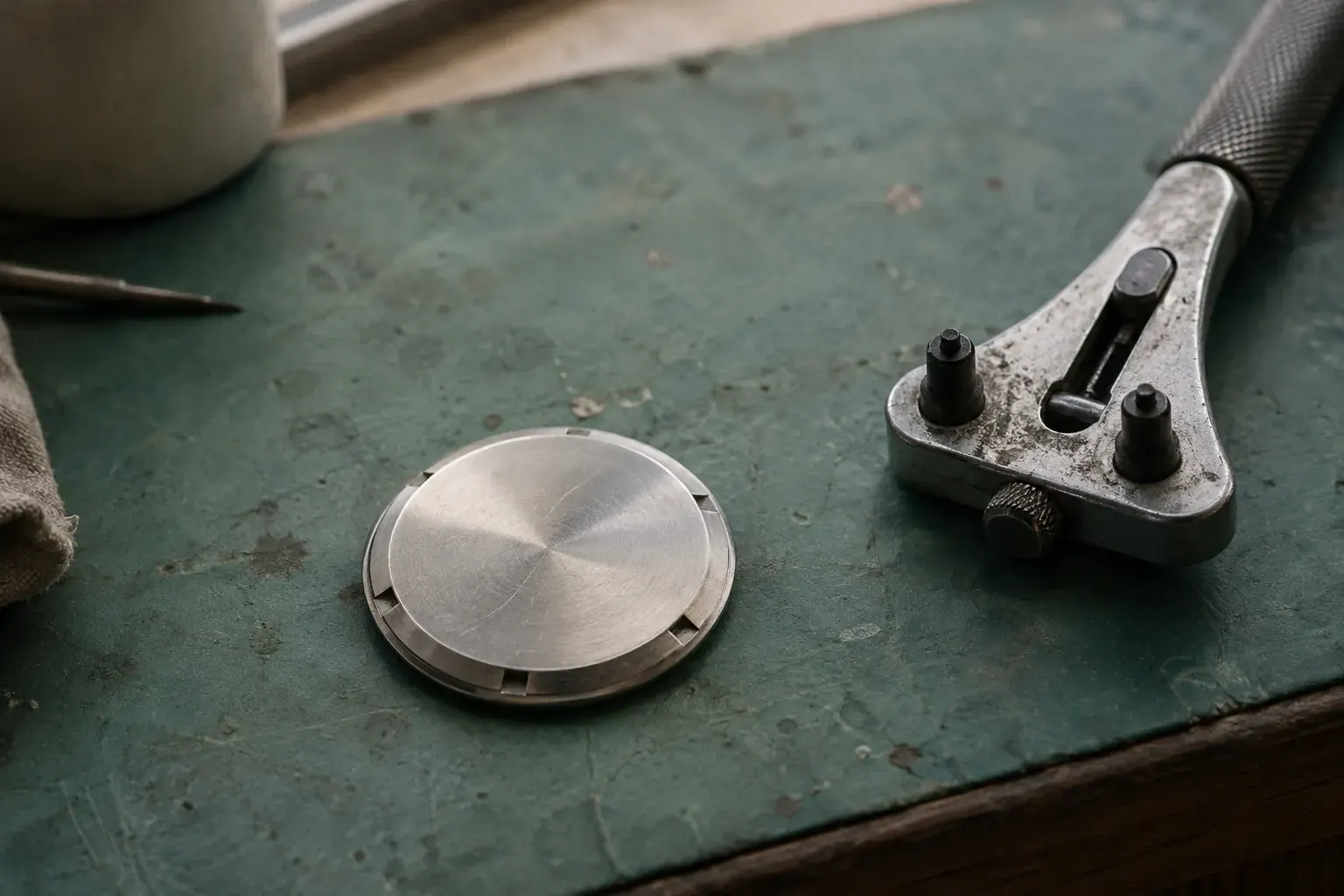
- Turn the watch over. A transparent caseback shows a rotor and a balance wheel if the watch is mechanical. A solid one carries codes instead: a Casio prints its module number, and a Seiko prints a case code, such as 7S26-0020, whose first characters are the calibre.
- Try the crown. On a mechanical watch the crown, in its first position, winds against a spring with a faint ratchet. Quartz has nothing to wind. Hand-winding is the exception on a few automatics, so no resistance does not rule one out.
- Look the calibre up. Search the number on the caseback or the model in the watch pages, which show the movement, or in movements. For dating a watch, the serial number lookup reads the same caseback.
What we do not have
- No movement is typed hand-wound or Kinetic, so those two rows count zero.
- 5 movement files state no type. They are left out of every count above, not guessed.
- Mecha-quartz is our grouping. The maker calls the calibres analogue quartz.
- Counts follow our collection. It leans toward Seiko, Casio, Citizen, Miyota, TMI, ETA and Sellita, so a type that other makers dominate would look smaller here than it is.
How a fact gets into the reference, and what “not published” means, is on the methodology page.