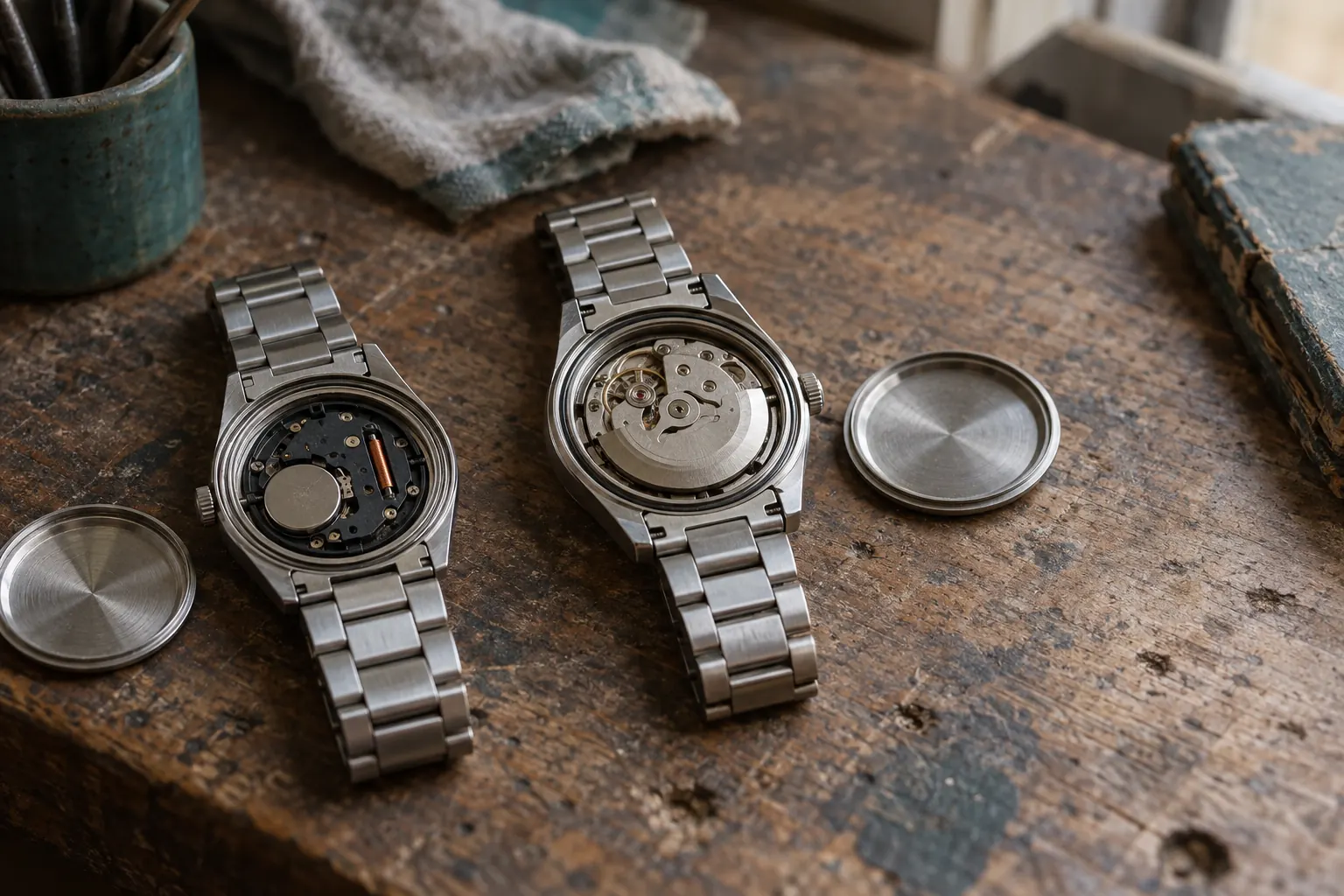
What each one is
A quartz watch counts the vibrations of a small quartz crystal that a battery, or a solar cell, keeps oscillating. A circuit turns that count into steps of the hands or a digital display. An automatic watch is mechanical: a mainspring drives a gear train, a balance wheel and hairspring set the pace, and a weighted rotor that swings with your arm winds the spring.
Here “quartz” means every electronic movement in the data, Casio’s digital and analog-digital modules included, and “automatic” means the mechanical movements. The hybrids, solar quartz, mecha-quartz and Spring Drive, are explained in the guide to movement types; the one Spring Drive we hold is mentioned where it changes a number.
The two side by side
| What differs | Quartz | Automatic |
|---|---|---|
| Pace set by | A quartz crystal. | A balance wheel. 38 movements beat 21,600 times an hour, as the NH35 does3; 24 beat 28,800, as the Miyota 9015 does5. |
| Power | A cell you replace, or light on solar models. | A mainspring wound by the rotor. 40 of the 43 movement files that say so can also be wound at the crown. |
| Rated accuracy | Most common: ±15 s/month1 (66 of 94 movements). Tightest ±5 s/month8, loosest ±30 s/month9. | Most common: −20 to +40 s/day2 (14 of 37 movements). Tightest −3 to +5 s/day10, loosest −35 to +45 s/day11. |
| Runs for | 1–10 years per battery in Seiko’s chart, most often 212. | 38 h13 to 80 h14 on a full wind; the middle movement 42 h. |
| Thickness of our watches | 7.3 mm15 to 19.4 mm16 across 45 models. | 6.8 mm17 to 15 mm18 across 122 models. |
| Seconds hand | Typically one step a second (general). | Sweeps: 6 or 8 steps a second reads as continuous motion. |
| Upkeep | A new cell when the old one runs down (general). | Periodic servicing by a watchmaker. Makers set the interval; our data does not carry one. |
Accuracy: seconds a month against seconds a day
Makers rate quartz per month and mechanical movements per day, which hides how far apart they are. Divide a monthly rating by 30 and both sit on one scale. The bars below run from the tightest to the loosest rating among the movements with a maker’s figure; the black tick is the middle one.
The middle automatic rating is 60 times looser than the middle quartz one. Spring Drive, Seiko’s mainspring-powered movement with an electronic regulator, falls on the quartz side of the gap: the 9R65 is rated ±15 s/month19.
What a rating does and does not tell you
A rating is the figure a maker commits to under stated test conditions. TMI’s technical guide measures the NH35 ten to sixty minutes after a full wind, in three positions, with the date mechanism out of play; Casio prints its figure “at normal temperature”. Neither is a prediction for a watch that is worn, bumped and left on a bedside table. Treat it as a limit, and measure your own with the watch accuracy calculator.
2 movements in the data publish an accuracy figure without saying whether it is per day or per month, so they are not counted in the groups above.
Power and run time
The two types run out of energy in opposite ways. A mechanical movement holds its energy in the mainspring, and across the 49 movements with a maker’s figure that is 38 to 80 hours on a full wind, 42 hours in the middle. Take such a watch off on Friday at six in the evening and it is still going on Sunday at noon, not on Monday morning. The longest, 80 hours, is Powermatic 80; the shortest, ETA 2836-2, is 38. 3 movements in the data cannot be wound by hand (6309, 7009 and 7S36), so a watch with one of them can only be restarted by wearing or shaking it.
A quartz movement spends a cell instead. Seiko’s own chart gives a battery life for 1,261 calibres: from 1 year to 10, with 2 years the most common (562 calibres)12. The chart is dated March 2011, revised March 2013, so newer calibres are not in it. Other makers’ files give single figures: Miyota 2035 3 years20 Sources disagree: manufacturer 3 years / manufacturer 4 years7, VH31 2 years22, and Casio 5125 3 years23.
Solar quartz is rated another way: how long a full charge lasts with no light at all. Citizen B612 7 months24 and Citizen A060 1.5 years25 are Citizen’s figures for a full charge run down to empty.
Thickness in the watches we hold
Quartz has a reputation for thin cases, and the data does not bear out the strong form of it. The median model is 13.5 mm thick among our 45 quartz watches and 13 mm among the 122 automatic ones. What differs is the spread.
All 40 quartz models here are Casio, from a flat digital to a bulky ruggedised case, and 112 of the 122 automatics are Seiko. We hold no automatic thinner than 6.8 mm, which says more about which models we collected than about what an automatic movement allows. 74 of our 241 watches have no thickness or no movement on file and are left out.
Which batteries quartz watches take
A mechanical movement takes none. For quartz, the cell sizes that most calibres in Seiko’s chart call for are these12:
| Battery | Calibres | Size |
|---|---|---|
| SR920SW | 153 | 9.5 mm26 × 2.05 mm26 Sources disagree: manufacturer 2.05 mm / secondary source 2 mm27 |
| SR621SW | 131 | 6.8 mm26 × 2.15 mm26 Sources disagree: manufacturer 2.15 mm / secondary source 2.1 mm27 |
| SR927SW | 124 | 9.5 mm26 × 2.7 mm26 |
| CR2025 | 84 | 20 mm28 × 2.5 mm28 |
| SR916SW | 83 | 9.5 mm26 × 1.65 mm26 Sources disagree: manufacturer 1.65 mm / secondary source 1.6 mm27 |
The size is the thing to check before buying a cell: two codes with the same diameter can differ in height by half a millimetre, and a lithium cell is not a drop-in for a silver-oxide one. The battery swap checker compares two codes, and the battery pages list every movement that takes each size.
Choosing between them
The numbers above point to a short list of trade-offs.
Quartz suits you if
- you want the tightest rating, down to seconds a month, with no resetting after a week in the drawer;
- you would rather change a cell every few years than wind or set the watch;
- you want what a module adds, from alarms and world time to a solar charge.
Automatic suits you if
- you want a mechanical movement that runs on motion and has no cell to run out;
- a few seconds a day is fine, and you will wear the watch often enough to keep it wound;
- you accept servicing at an interval the maker sets rather than a battery swap you can do yourself.
What this comparison cannot tell you
- Ratings are not measurements. They are the makers’ figures under their test conditions. We list only ratings from the maker; a reference site’s figure is shown on the movement page but left out here.
- The sample is ours. 94 quartz and 37 mechanical movements with a usable rating, and 167 watches with a thickness, are the ones collected so far, tilted toward Seiko, Casio, Citizen, Miyota, TMI, ETA and Sellita. High-end mechanical movements are missing.
- Battery life is Seiko’s. The large table is one maker’s chart from 2011–2013; other makers appear as single figures.
- No price, no service cost, no lifespan. We hold no data on any of them, so we do not compare them.
- No Kinetic or hand-wound-only calibre yet. Both appear in the guide to movement types with that gap marked.
If a figure here does not match your watch’s document, tell us on the corrections page; how we source and rank numbers is on the methodology page.